World Listens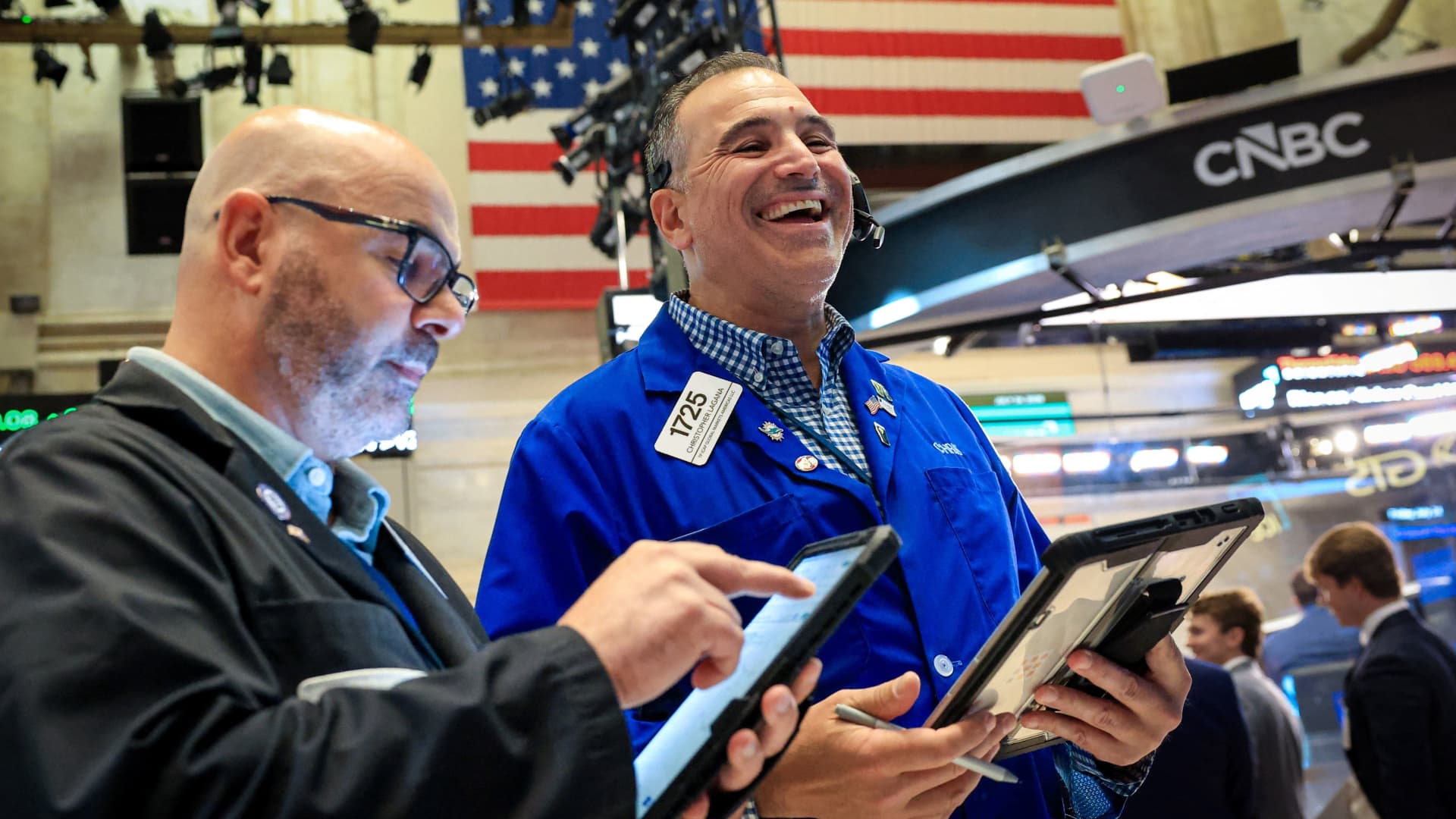
This is CNBC's Morning Squawk newsletter. Subscribe here to receive future editions in your inbox. Happy Wednesday.
Even the Television Academy is cutting the cord. Starting next year, the Emmy Awards will stream on Amazon Prime Video under a six-year exclusive deal announced yesterday. Stock futures are pulling back this morning after the S&P 500 closed at a record yesterday.
Here are five key things investors need to know to start the trading day: 1. On the record Traders work on the floor at the New York Stock Exchange (NYSE) in New York City. Brendan Mcdermid | Reuters Stock investors have officially climbed yet another wall of worry.
The S&P 500 ended yesterday's session above 7,800 for the first time , marking its first record close in nearly two months. Here's what to know: The Nasdaq Composite also sailed to a fresh all-time closing high for a second straight session, underscoring the recent strength in tech stocks. Chipmakers, in particular, lifted the tech-heavy index: Marvell Technology rose 5.8%, Advanced Micro Devices added 3% and Broadcom gained 3.7%.
U.S. Treasury yields also provided upward momentum for the stock market Tuesday, as the 10-year Treasury yield and 30-year Treasury yield pulled back from their multi-decade highs. Treasury yields and crude oil prices are both higher before the bell, putting pressure on stock futures.
Investors will be monitoring this afternoon's release of minutes from the Federal Reserve's September meeting, at which the central bank announced its first rate hike in three years. Treasury yields could get another test today thanks to a closely watched bond auction, where the Treasury Department plans to sell $39 billion of 10-year notes. Follow live market updates here. 2.
Frosted financials Signage in front of a Minneapolis bookstore references immigration officers. Alex Harring | CNBC President Donald Trump has directed federal immigration officers to descend on major U.S. cities in his second term. A growing body of research shows that where Immigration and Customs Enforcement conducted raids, an economic chill has tended to follow.
A University of Pennsylvania study found that communities subject to ICE raids saw pullbacks in spending and foot traffic, which University of Pennsylvania professor Zeke Hernandez said can result in "recession-like conditions." The Brookings Institution reported last month that employment fell in cities most impacted by ICE raids. CNBC traveled to Minneapolis, where the Department of Homeland Security conducted Operation Metro Surge — what it billed as the largest-ever immigration enforcement event. The city estimates it lost almost $700 million in economic activity between December and April, and the state has seen its unemployment rate spike, outpacing the national average for the first time in nearly two decades. 3.
Agent training Samuel Boivin | Nurphoto | Getty Images In an effort to improve the experience of doing business with an artificial intelligence bot, Meta is teaming up with Walmart , Stripe, Sierra and other companies to publish a "personal agent protocol." The protocol will be an open standard intended to clarify how AI agents can interface with businesses, CNBC's Kate Rooney reports. Sierra co-founder Bret Taylor, who's leading the initiative, told CNBC that without such a rulebook "it is kind of chaos." Anthropic also has its eyes on its business customers. The AI startup yesterday announced a build-out of its Claude Startups program , its latest effort to win founders and growing companies.
The expansion will open the program to more companies, and members will get access to thousands of dollars' worth of products and credits. 4. Risk report The Webull logo is displayed on a smartphone screen. Rafael Henrique | SOPA Images | LightRocket | Getty Images A bipartisan congressional panel said in a report this morning that online trading platform Webull is "tied in structural ways" to the Chinese government, making it a national security threat to U.S. finance.
As CNBC's Eamon Javers writes, the House Select Committee on China alleges that the trading platform's "software development, data pipelines, and core engineering operations" all rely on infrastructure subject to Beijing's laws, which can force companies to cooperate with its government. The committee also said Webull misrepresented how many of its employees are based in China. Shares of Nasdaq-listed Webull are down nearly 30% in premarket trading this morning.
As spokesperson for the company said "It is deeply disappointing that the Select Committee published a report containing significant inaccuracies and unsupported conclusions without ever seeking clarification from Webull." 5. House race Real estate in Allentown, Pa. Laura Garrison | CNBC Surveys show that housing costs have become a top political issue for young adults.
But that doesn't mean they expect political candidates to help. The CNBC and SurveyMonkey Quarterly Money Survey released this week shows that Americans feel stretched by shelter costs — especially if they're renting. The data comes as mortgage rates climb at a faster clip and housing prices keep rising.
CNBC's Diana Olick traveled to Pennsylvania, a key swing state whose House races this November could determine which party controls Congress. While housing costs in the Keystone State are below the national average, the share of income needed has risen in recent years. The Daily Dividend The U.S. trade deficit in August widened to its highest level since March 2025.
Here are the key numbers, according to the Commerce Department: Total deficit: $105.6 billion Month-over-month increase: 13.7% — CNBC's Deena Zaidi, Sean Conlon, Spencer Kimball, Kate Rooney, Ashley Capoot, Eamon Javers, Diana Olick and Jeff Cox contributed to this report. Caleigh Keating assisted in the production of this newsletter. Josephine Rozzelle edited this edition.
Source: CNBC